
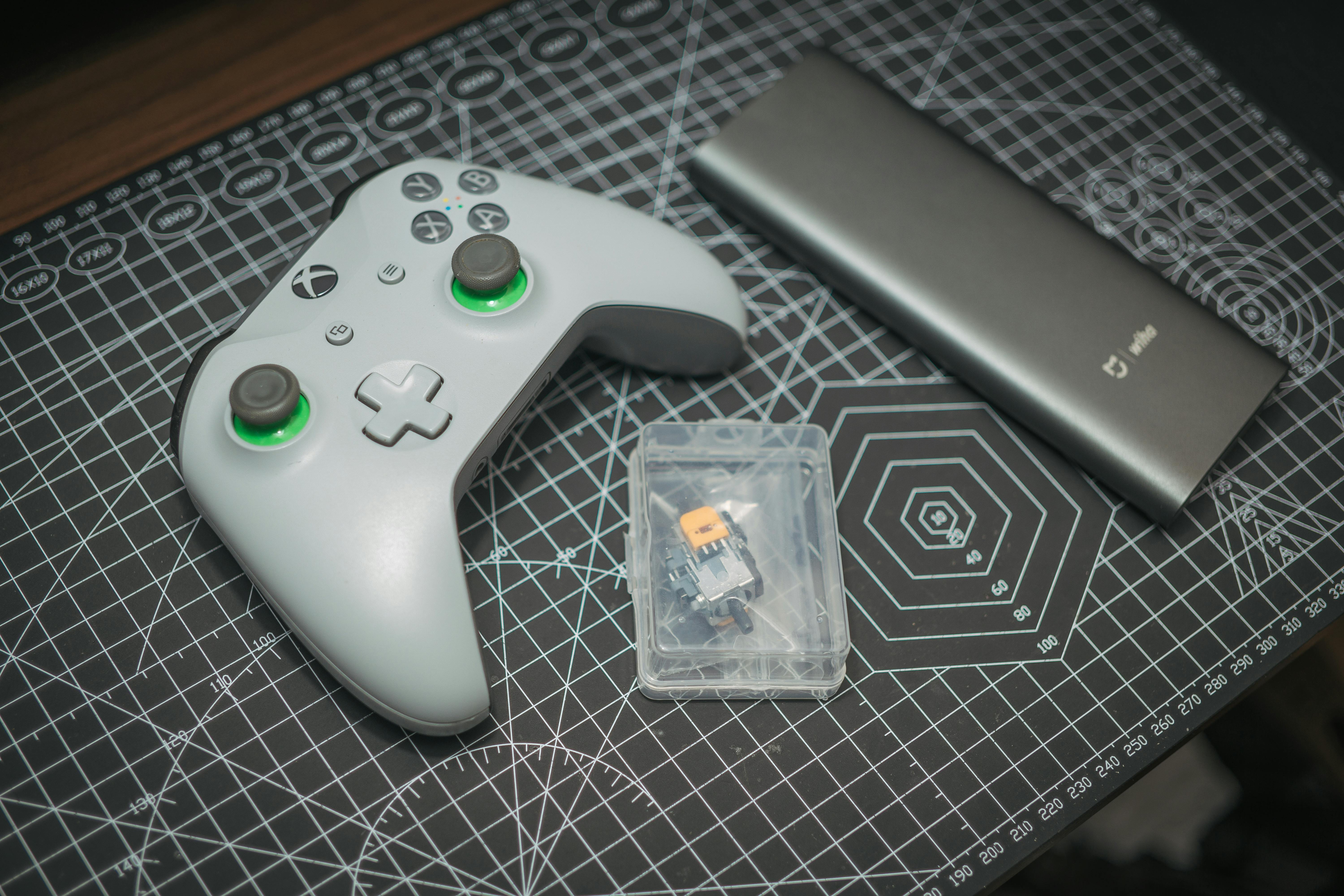
A controller that moves the camera when nobody is touching it has drift. The cause is mechanical wear in a component that was never designed to last indefinitely.
How a stick reports its position
Most analogue sticks use two variable resistors, one for each axis. A contact sweeps across a resistive track and the voltage at that point encodes the angle.
The console reads those voltages continuously and converts them into coordinates. There is no discrete notion of centred; centre is simply a particular voltage pair.
That makes the reading sensitive to anything that changes resistance along the track, including wear, dust and oxidation.
Wear is the normal failure mode
The contact physically rubs the track every time the stick moves. Over millions of movements the track erodes, most heavily in the region used most often.
Debris from that erosion collects inside the housing and interferes with the contact. Skin oils and dust entering through the shaft opening add to it.
The result is a resting voltage that no longer matches the value the console expects for centre, which reads as constant gentle input.
Deadzones hide the problem until they cannot
Software ignores small deviations around centre, which is why a slightly worn stick behaves normally. This deadzone masks early drift entirely.
Once the resting offset exceeds the deadzone, the input becomes visible all at once. Drift appears sudden even though the wear was gradual.
Widening the deadzone restores the appearance of health at the cost of precision near centre, which matters most in aiming.
Recalibration treats a symptom
Calibration tells the system which voltage to treat as centre, so it can compensate for an offset that is stable. It is a genuine fix for a stick that was assembled slightly out of true and has stayed that way.
Wear is not stable in that sense. The offset continues to change as the track erodes further, so the correction stops matching within weeks and the drift returns in the same place it was before.
Cleaning the contact with a solvent has a similar shape. Removing accumulated debris restores the reading temporarily, but it cannot restore material that has already been worn away from the track.
The alternative design trades cost for lifespan
Magnetic sensors detect the position of a small magnet without any contact touching a track, which removes the wearing surface that causes the failure entirely. Nothing rubs, so nothing erodes.
They cost more per unit and require different calibration behaviour in firmware, which is why contact-based sticks remained standard in high-volume controllers for so long. At scale, a small unit cost difference is a large total.
The tradeoff is straightforward: a component that is cheap at manufacturing scale, in a device used for thousands of hours, will eventually wear through.